
Why Cheaper Meals and High Labour Costs Don’t Matter When Gaming Drives the Club’s Revenue
-
Why Cheaper Meals and High Labour Costs Don’t Matter When Gaming Drives the Club’s Revenue

FREE Mini-Course - 5 Step System to $30K Profit
5 Exact steps that I took to transform a large volume bistro from a $300,000+ loss to a $30,000 profit within 30 days

Free Course – the one $2 metric you should focus on today
Get The One Single Metric That You Should Focus on To Increase Your Restaurant Profits...Immediately


In the hospitality industry, particularly in clubs and community venues, managers constantly face the same debate:
Should we raise menu prices to improve food margins — or keep them low to attract more members and guests?
At first glance, it might seem logical to improve profitability by increasing menu prices or reducing labour costs. But in many clubs, the real profit engine isn’t the kitchen — it’s the gaming floor.
That’s why many venues deliberately offer cheaper meals, accept lower food margins, and maintain higher-than-average labour costs — because the goal isn’t just to make money from food. The goal is to get people through the door, keep them longer, and increase overall club revenue.
This is the economics of the gaming-supported hospitality model, and understanding it is critical to running a successful modern club.
1. The Bigger Picture: How Clubs Make Money
Unlike standalone restaurants or cafes that rely solely on food and beverage sales, clubs operate on a multi-revenue model. The key income sources usually include:
Gaming machines
Bar sales
Food sales
Membership fees
Functions and events
Community grants or sponsorships
In this model, gaming is almost always the largest and most reliable contributor to total revenue.
A typical profit breakdown for a medium-sized club might look like this:
Gaming: 60–75% of total revenue
Bar: 15–25%
Bistro/Food: 5–10%
Functions/Other: 5–10%
With these numbers in mind, it becomes clear that the bistro isn’t the profit centre — it’s the magnet that draws people in to spend time (and money) elsewhere.
The Strategic Role of the Bistro: A Lead Generator, Not a Profit Centre
In a gaming venue, the bistro acts like marketing — it’s the entry point for most visitors.
When a club offers affordable, high-quality meals, it:
Attracts new customers who might not otherwise visit.
Encourages repeat visits through word-of-mouth and community loyalty.
Drives longer stays, increasing bar and gaming spend.
Positions the club as value-driven and community-focused, building trust and engagement.
Put simply, the meal is the hook, but the gaming floor is the payoff.
Example: The Power of a $20 Meal
Let’s imagine:
A couple comes in for a $20 meal special.
The club makes a $2 profit on each meal after costs — small, but intentional.
They stay for two hours, have a drink each, and maybe play the gaming machines.
If each guest spends $40 on gaming, and the club’s gaming profit margin is around 35%, that’s $14 profit per person.
That’s $28 profit from gaming alone, plus $4 total from the meals, and $8 from bar sales.
Total = $40 profit from one couple — even though the meals themselves barely broke even.
Multiply that by 100 or 200 guests a day, and you can see how cheaper meals make perfect business sense when gaming is the primary income source.
Why Food Cost Percentages Don’t Matter (As Much)
In a standalone restaurant, chefs obsess over maintaining food costs below 30%. Anything higher, and the operation risks losing money.
But in a club setting, the context is different. Food cost percentages can be misleading because they don’t account for the broader financial ecosystem.
For example:
A bistro may run at 38–42% food cost, higher than industry averages.
Labour might sit at 38–40%, again above standard restaurant benchmarks.
On paper, this looks inefficient — but if the club is generating strong gaming and bar revenue, it’s still achieving a higher overall profit per head than a restaurant with lower costs.
In other words, profitability per customer, not per dish, is the real measure of success.
Example Calculation:
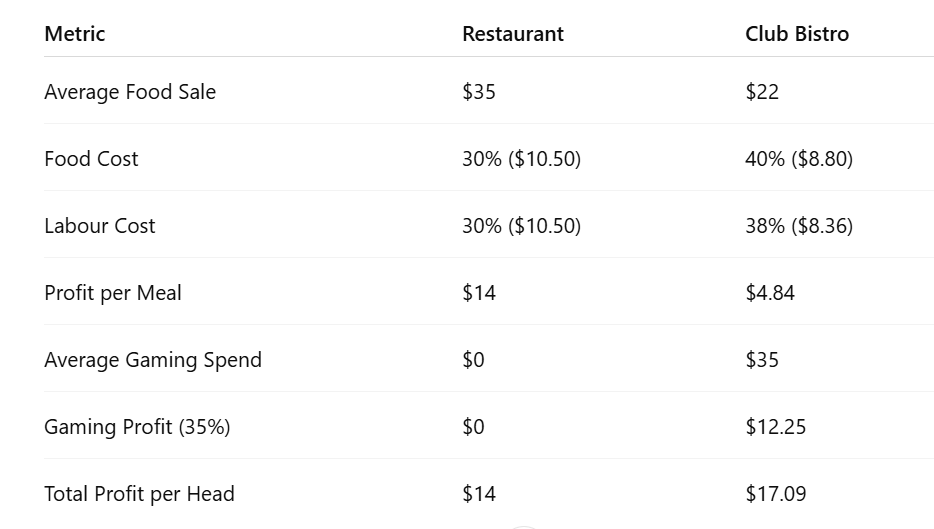
Even though the club’s food profit is lower, the total customer value is higher thanks to gaming.
That’s the strategic difference between food as a revenue source and food as a marketing tool.
The Psychology Behind Value Pricing
Customers love value. When clubs offer affordable meals, it sends a clear message:
“We care about our members and the community.”
That emotional connection builds loyalty. People return more often, bring friends and family, and spend more over time.
Clubs that maintain value-based menus often enjoy:
Higher visitation frequency
Stronger weekday trade
Increased average dwell time
Greater bar and gaming participation
In short — cheaper meals create traffic and trust.
Even if the kitchen operates at a thin margin, the halo effect on the rest of the club’s operations far outweighs the cost.
Labour Costs: Why They’re an Investment, Not a Burden
High labour costs often raise alarm bells for managers and accountants, but in a club, staffing levels correlate directly with customer experience.
Friendly, efficient, and well-staffed bistros ensure:
Faster service, which improves satisfaction.
Shorter wait times, which keeps guests in the building.
Better upselling at the bar and gaming floor.
A welcoming environment that feels more like a community than a business.
Unlike a restaurant trying to squeeze every dollar from payroll, a club’s return on labour investment is measured in total customer spend — not just food sales.
A strong team is a sales tool, not an expense.
Cross-Department Synergy: How Each Area Supports the Other
A successful club operates like a well-oiled machine. Every department plays a role in the bigger financial ecosystem.
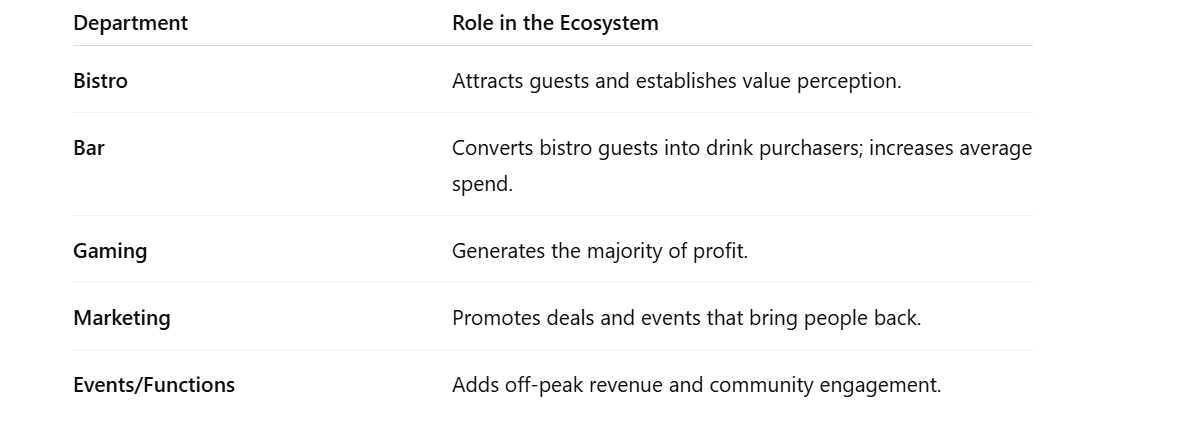
Each department supports the others. When the bistro is busy, bar and gaming naturally benefit. When gaming is thriving, memberships and loyalty increase, driving repeat visits to the bistro.
That’s why measuring the bistro’s success in isolation misses the point.
The club’s profitability comes from integration, not separation.
Case Study: The “Value Bistro” Strategy in Action
Let’s look at a real-world example of how this model plays out.
The Riverside Club (a regional venue in Victoria) ran a standard bistro with an average main meal price of $28. Their food cost was 34%, and labour 36%. They decided to lower meal prices to attract weekday traffic — introducing $18 specials and $10 lunches.
In the first 3 months:
Bistro revenue dropped 8%.
Bistro labour cost rose slightly (more staff needed for volume).
Gaming revenue increased 22%.
Bar sales rose 14%.
Total club profit increased by 11%, despite the kitchen technically becoming less profitable.
Their takeaway?
“We stopped chasing bistro margins and started focusing on total spend per guest. That’s when everything changed.”
The Data-Driven Way to Justify the Model
To get buy-in from boards or managers who fixate on percentages, shift the discussion from cost ratios to profit per customer visit.
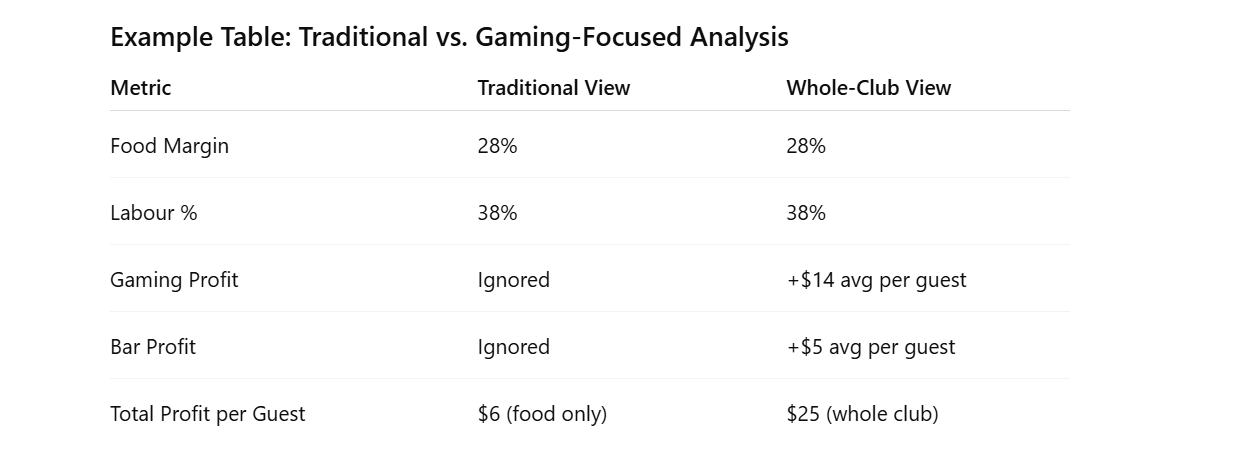
The Marketing Value of a Busy Bistro
An active, full dining room doesn’t just generate revenue — it signals vibrancy. It creates social proof that attracts more people.
Empty seats make people second-guess visiting. A full bistro, on the other hand, draws in walk-ins and boosts reputation.
And for clubs, perception matters.
A bustling bistro means more gaming participation, stronger community engagement, and a better overall member experience.
The Hidden Cost of Chasing Margins
When clubs chase “perfect” food and labour costs, they often end up making damaging operational choices:
Reducing staff, hurting service quality.
Increasing menu prices, scaring off price-sensitive locals.
Cutting portion sizes, eroding trust.
These actions may improve short-term metrics but harm long-term loyalty and gaming revenue — the very thing that sustains the club.
It’s far better to maintain consistent value and quality, even if it means higher labour and food percentages. The long-term gains in gaming and bar trade will always outweigh the short-term savings.
How to Measure Success in a Gaming-Driven Venue
If standard restaurant KPIs don’t apply, what should clubs measure instead?
Here are smarter metrics:
Average spend per guest (total club)
Gaming participation rate (visitors who play)
Dwell time (how long guests stay)
Repeat visit frequency
Customer satisfaction/NPS scores
Profit per guest visit (across all departments)
These indicators show how effectively your whole business — not just the kitchen — converts traffic into profit.
Leadership Mindset: Balancing the Numbers with the Mission
Good club leadership means recognising the strategic purpose of each department.
Food and labour should be managed carefully, but not at the expense of guest experience or member value.
Leaders who understand this balance focus on:
Sustainable community engagement
Operational excellence that supports the bigger picture
Investing in service, not just cutting costs
The best managers don’t obsess over spreadsheets — they look at the floor and ask,
“Are people happy, comfortable, and spending time with us?”
If the answer is yes, the numbers will take care of themselves.
The Future of Club Dining: Experience Over Margin
Looking ahead, the clubs that will thrive are those that see the bistro as an experience driver — a reason for people to visit often, stay longer, and spend more.
Some forward-thinking clubs are already enhancing their food offering as part of a whole-of-venue strategy:
Themed dining nights tied to gaming promotions.
Local produce menus that align with community values.
Member-only dining discounts that encourage loyalty.
“Eat, drink, play” packages combining meals and gaming credits.
These strategies don’t focus on food profit — they focus on total spend uplift.
Think Bigger Than the Bistro
The next time someone questions why the club offers such cheap meals, remember this:
The goal isn’t to make money on the plate — it’s to make money through the experience.
When guests feel they’re getting value, they stay longer, spend more, and come back often.
That loyalty drives gaming revenue, bar sales, and community reputation — far beyond what the kitchen alone could ever deliver.
So, cheaper meals with high food and labour costs can absolutely make sense — because in a gaming-supported business model, the real profit lies in keeping people connected, comfortable, and coming back.
Resturant Accelerator | Copyright 2023 | T&C | Home